Mining Dispute in Mankayan, Benguet Continues Over Threats to Water Source, Agricultural Livelihoods
For residents, protecting their ancestral land remains a priority as they seek to prevent further mining activities in their communities.
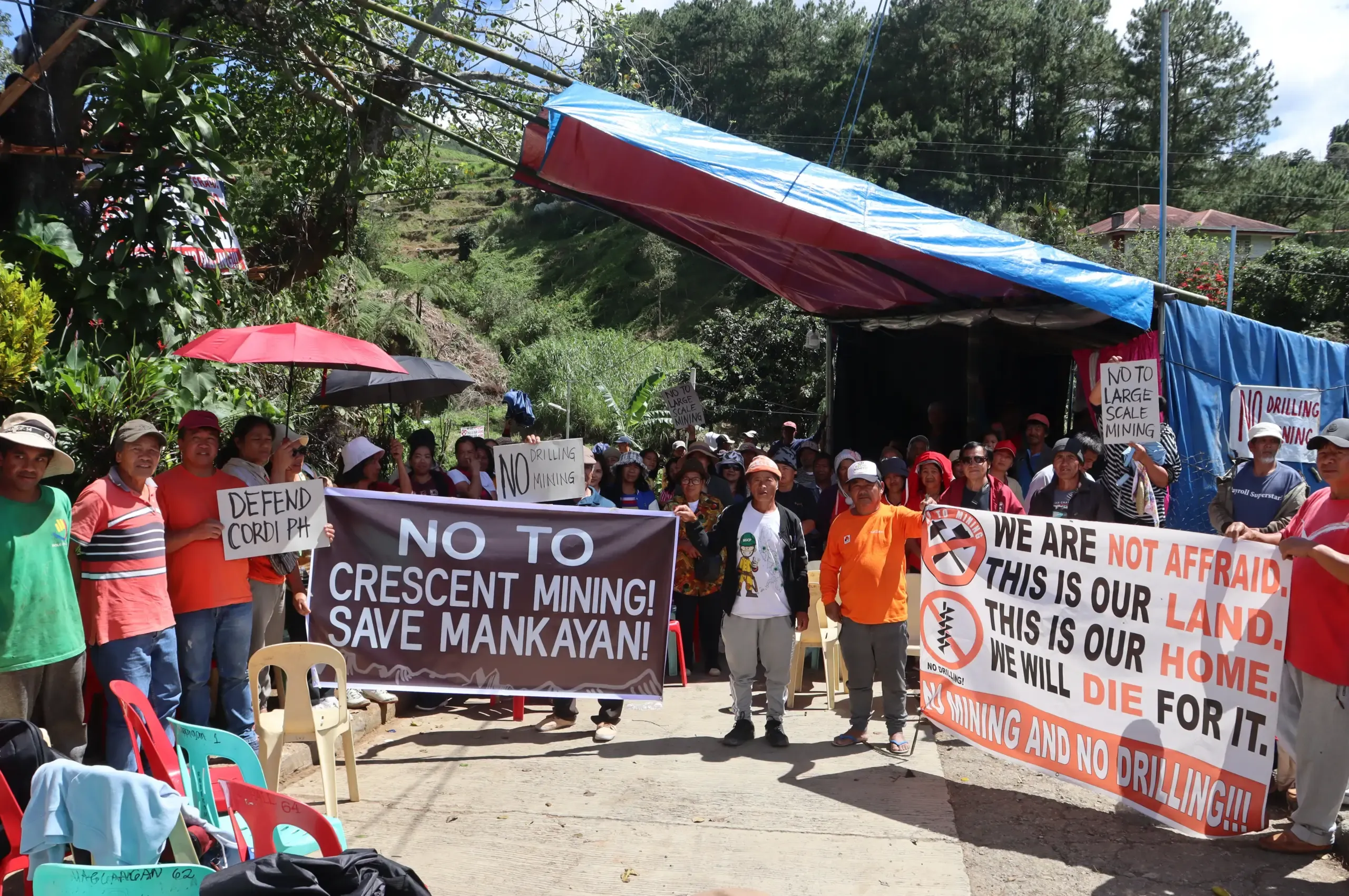
Indigenous residents of Bulalacao and Guinaoang in Mankayan, Benguet hold banners opposing Crescent Mining and Development Corporation’s proposed exploration as they call for the protection of their ancestral land. (Marlo Pablo/Northern Dispatch)
The Indigenous residents of Barangays Bulalacao and Guinaoang in Mankayan, Benguet continue to block access to Crescent Mining and Development Corporation's (CMDC) proposed mining exploration sites, as concerns persist over the project’s possible impact on ancestral land, water resources, and agricultural livelihoods.
The residents have maintained the barricades since October 2025, blocking CMDC from bringing in equipment despite a writ of preliminary injunction issued on Aug. 20 by the Regional Trial Court (RTC) Branch 64 in Buguias, ordering the blockade’s removal.
This resistance stems from the communities’ concerns about the potential effects of mining exploration on agriculture and water sources, which they rely on for their livelihoods, according to Santos Mero, a member of the non-governmental organization Center for Development Programs in the Cordillera (CDPC).
“Unang-una, ang livelihood dun is agriculture at yun ang number one livelihood ng mga mamamayan diyan. Pangalawa, pagkawala ng tubig,” Mero said in an interview with Likas.
He added that residents fear additional mining and exploration could eventually lead to further land classification disputes, waste disposal, air pollution, and community displacement.
The ongoing barricades, however, have also affected residents' daily activities and livelihoods.
"Imbes na dati ay pumapasok doon sa kalsada, dahil nga may barikada, sakripisyo ng mga mamamayan na buhatin papasok ang anumang pupunta sa community. Tapos mano-mano ulit na buhatin yung mga product palabas sa kanilang gardens," Mero said.
Farmers and residents also take turns maintaining a 24-hour watch at the barricade to prevent CMDC personnel and equipment from entering the area, he added.
Questions Over Informed Consent
The standoff is also rooted in a longstanding dispute over the proposed project’s permits and the process through which the exploration activities were approved.
The CMDC received a 25-year Mineral Production Sharing Agreement (MPSA) in 1996, which Mero said was issued without proper community consultation. The government later granted them another 25-year MPSA in March 2022.
In 2024, the National Commission on Indigenous Peoples (NCIP) conducted community consultations on the proposed project as part of the free, prior, and informed consent (FPIC) process, which included voting among barangays in the area.
Mero said the consultations involved disagreements among the communities, with residents of the two directly affected barangays voting against the proposed project while other barangays voted in favor.
“Since then, ang ginawa ng NCIP ay binigyan ng [FPIC] yung mining company na parang ang nangyari is minority against majority. Sa batas naman, sinasabi niya consensus. Ibig sabihin, [kapag may] nag-o-oppose na isa o dalawa, […] ibig sabihin walang consensus. Pero na-violate yun,” Mero said.
The dispute has prompted congressional action. Benguet Rep. Eric Go Yap filed House Resolution No. 1451, calling for a congressional inquiry into the circumstances surrounding CMDC's proposed exploration activities, including compliance with legal requirements and the rights of affected Indigenous communities.
Likas reached out to CMDC for their comments but has not received a response as of press time. Some reports, however, stated that CMDC has maintained that its exploration activities are lawful and permitted. They have also expressed willingness to pursue a peaceful resolution.
On Sept. 20, CMDC reportedly pulled back four vehicles from the Mankayan standoff to ease tensions, while clarifying that the move did not constitute a withdrawal from the proposed exploration project.
For residents, protecting their ancestral land remains a priority as they seek to prevent further mining activities in their communities.
“Sa isang mamamayang katutubo, ang lupa ay hindi minana sa ninuno, kundi ito ay hiram sa susunod na henerasyon. So therefore, it is our duty to guard and to protect so that the next generation will use this. At yun ang isang dahilan kung bakit ayaw nila na masira o mawala ang kanilang ancestral land,” Mero said.
EDITOR'S NOTE: The article has been revised to remove a portion that mentioned another mining company and to clarify the publication's efforts to reach out to CMDC.
Keep reading
News section
As El Niño Looms, Hospitals Brace for Water and Power Shortages
Govt Efforts to Relieve Farmers for Upcoming Super El Niño are Insufficient—Peasant Group