Amid Lack of Green Third Spaces, People Struggle to Find Respite and Community
With no affordable third location due to the lack of green spaces in Metro Manila, people experience isolation and burnout as they’re forced to either stay inside their homes or spend money in commercial spaces to seek respite.
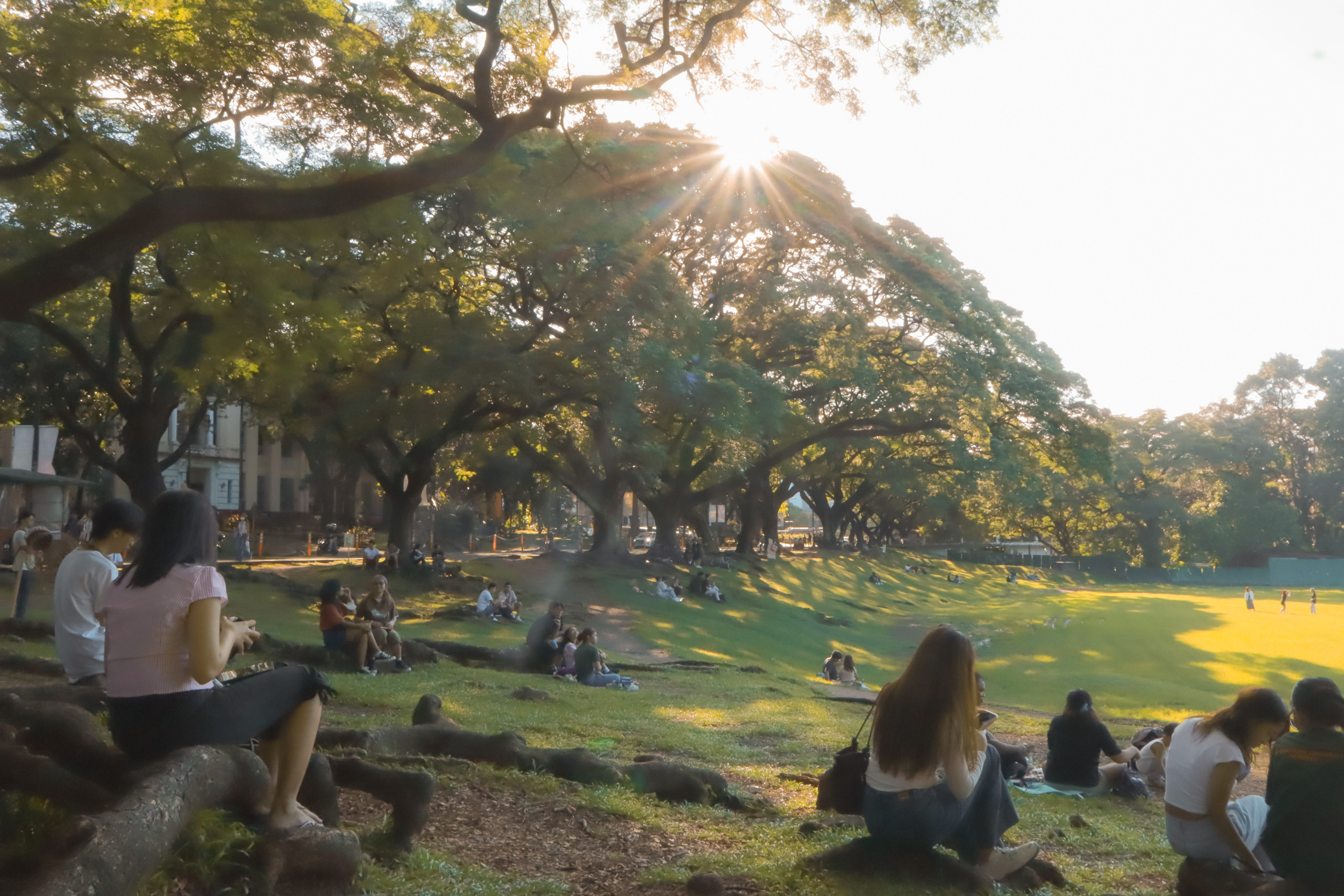
Multiple UP Diliman students and civilians spend time doing various leisure and social activities in Sunken Garden at UP Diliman. The Sunken Garden is one of the few publicly available green third spaces that exist within the Metro. (Hershey Sta. Brigida/Likas Publication)
With no affordable third location due to the lack of green spaces in Metro Manila, people experience isolation and burnout as they’re forced to either stay inside their homes or spend money in commercial spaces to seek respite.
Metro Manila is a densely populated metropolis, labelled not only the Philippines’ capital, but also the country’s “social, cultural, educational and political center”. Yet, in contrast to the country’s agricultural roots, it is a concrete jungle whose green spaces largely either exist as amenities in gated estates or are actively being cut despite existing for decades.
In addition to the lack of public green areas, third spaces in general do not suffice to meet the needs of a fast-paced city, wherein cases of isolation and burnout are widespread.
Such is the case of Bianca Catane, a third-year journalism student at UP Diliman whose 24-hour day limits her existence to two places: her home in Pasig, and her campus in Quezon City – both existing hours away.
“Parang tuloy-tuloy na bumabalik ako, pumupunta ako sa classes and umuwi ako and then pag-uwi ko, kailangan kong gumawa ng mga homeworks ko, and mag-prepare sa mga exams ko,” she said.
(As if I continuously go back and forth between my classes and my home. Then, once I go home, I need to do my homework and prepare for my exams.)
Amid navigating her busy life of managing her academics and extracurricular activities within campus, she lamented that there are limited third spaces to hang out within campus whenever she needs to unwind between classes.
Third spaces in UP Diliman
According to urban sociologist Ray Oldenburg, a third space is a social environment separate from home (the first place) and work (the second place). It is designed to minimize self-isolation and increase social interaction.
One might think of UP Diliman as a decent bastion of third spaces; the Sunken Garden in its full glory shines brightly in the sunset as kids play soccer in it, the oval is filled with joggers and trees that cool their warmed-up bodies, and the buildings all have libraries equipped for students.
Yet for Vhin Diezell Benitez, another third-year journalism student who lives in a dormitory near campus, the third spaces in UP Diliman are not conducive to the students' needs.
“Ang pangit ng wifi dito. Like andami kong mga kaklase magsasabi sila ‘wala akong wifi ang hina ng DilNet’ […] Even in UP, the study spaces are not conducive for learning […] Kahit naka noise-cancelling headphones ako, rinig na rinig ko pa rin yung ingay,” he said.
(The wifi here is bad. Like I have many classmates who say ‘I have no WiFi because DilNet is slow’ […] Even in UP, the study spaces are not conducive for learning […] even if I wear noise-cancelling headphones, I can still hear the noises.)
The pressing issue of facilities, especially poorly built dormitories and lack of accessibility for disabled people in UP Diliman, has been persistent, even more so due to the opening of Dilimall, which advocates criticized as a reflection of the university’s ill-placed priorities that chose to add another commercial space instead of building more green spaces or affordable third spaces.
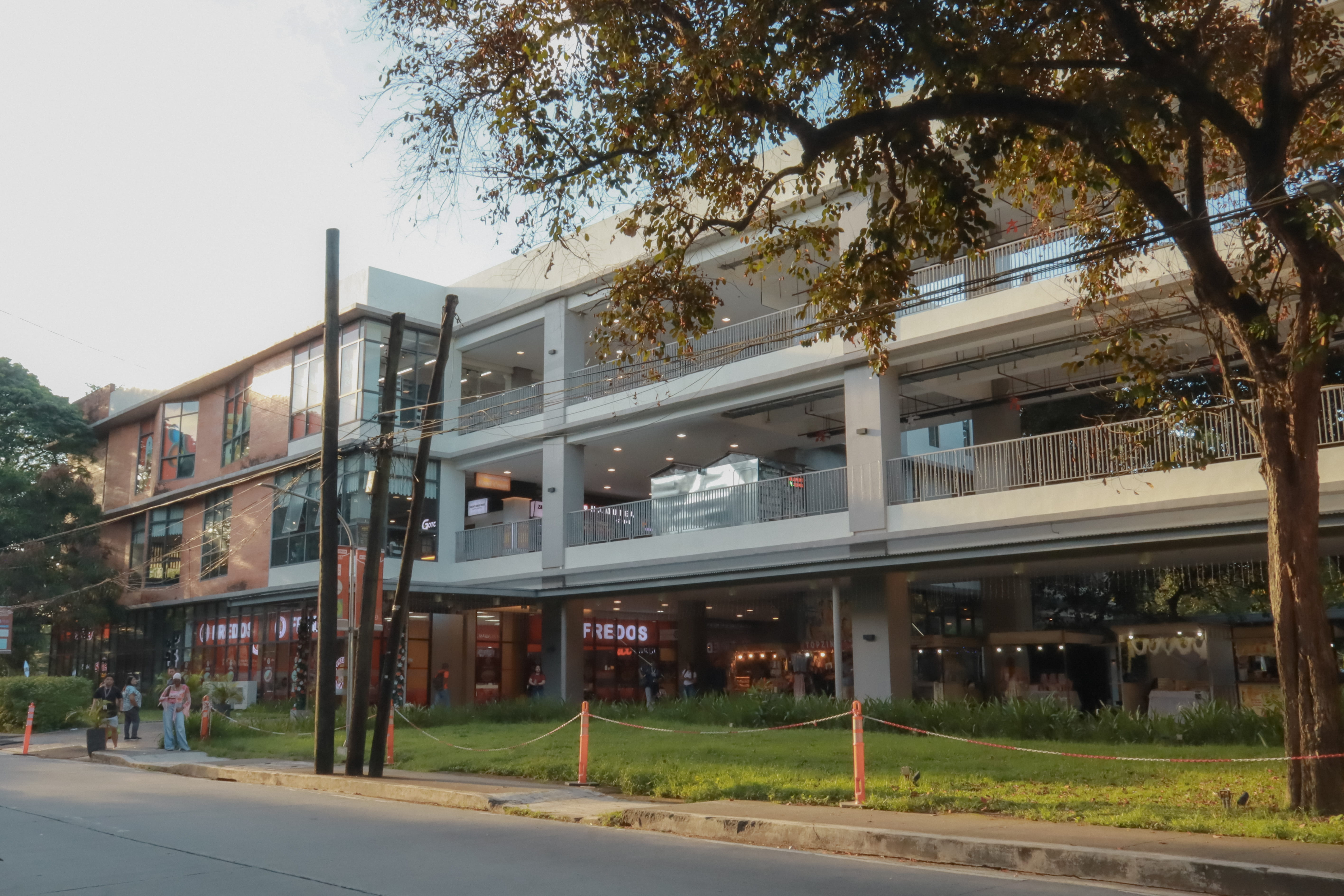
UP Shopping Center, also known as 'Dilimall,' now occupies space along Laurel Avenue, UP Diliman, after its official opening last November 2024. (Hershey Sta. Brigida/Likas Publication)
It is reminiscent of Philippine history, for in the aftermath of World War II, private entities jumped in and built huge, commercial shopping malls. A ‘public space’ built for profit.
The issue persists, as due to the lax implementation of zoning regulations, developers have been allowed to replace open spaces with malls, hotels, and commercial buildings.
For Catane, she hopes that spaces like the Academic Oval, where people can jog and exercise freely, are more widespread, as her sister would often travel to UP Diliman to jog.
“Why does she have to go all the way to Quezon City, commute there, just to go jogging? Why can't she do it someplace here? But then there's no available spaces here that are suitable for it,” she said.
The lack of recreational spaces like the Oval is an issue, especially when data from the Department of Science and Technology-Food and Nutrition Research Institute (DOST-FNRI) showed that 77.5% of adolescents are physically inactive in 2025. Mildred Guirindola, chief science research specialist at the DOST-FNRI, theorized that this may be in relation to a lack of recreational spaces.
The bigger picture
The World Health Organization recommended that each person have a nine-square-meter green space, a far cry from Metro Manila’s five-square- meter greenery, most of which are private properties rather than public spaces.
As one of the solutions, the UP administration designed a project: The UP Sustainable Development Goals (SDG) Urban Farm and Wellness Park. A lush landscape that positions itself as a pro-environment initiative in service of its students and the community.
Yet, it dragged locals and Krus Na Ligas farmers from Pook Aguinaldo into conflict over the land they’ve lived on for multiple generations. Disturbances and surveillance by armed personnel also occurred with no prior warning. Furthermore, the urban poor settlers are set to be displaced with no promise of proper relocation.
This scene is reflective of the situation in other areas, leading to more problems as felt by Catane and Benitez.
In light of tree cutting in Metro Manila, hotter weather due to the impacts of climate change, mental health issues partly attributed to lack of community, and burnout due to multitudes of responsibilities, the desire for a better environment and more third spaces is not lost among Filipinos.
For Benitez, who mentioned that mentally rewinding at malls cost him up to a thousand pesos, emphasized the importance of having low-maintenance and cost-free spaces.
“For recreational purposes mga parks where pupunta ka lang tapos kahit uupo ka lang. ‘Di mo kailangang maglibot or gumastos like for example Sunken, like dito mo makikita yung mga highschool students na nandyan meron silang blanket tapos kakain sila. Yung ganun lang. Para low maintenance and also libre,” he said.
(For recreational spaces, I want to see more parks where you can just go and sit. You don’t have to wander around or spend. For example Sunken Garden – you’ll see high school students that are there who bring blankets with them and eat. Something like that. It’s low maintenance and free.)
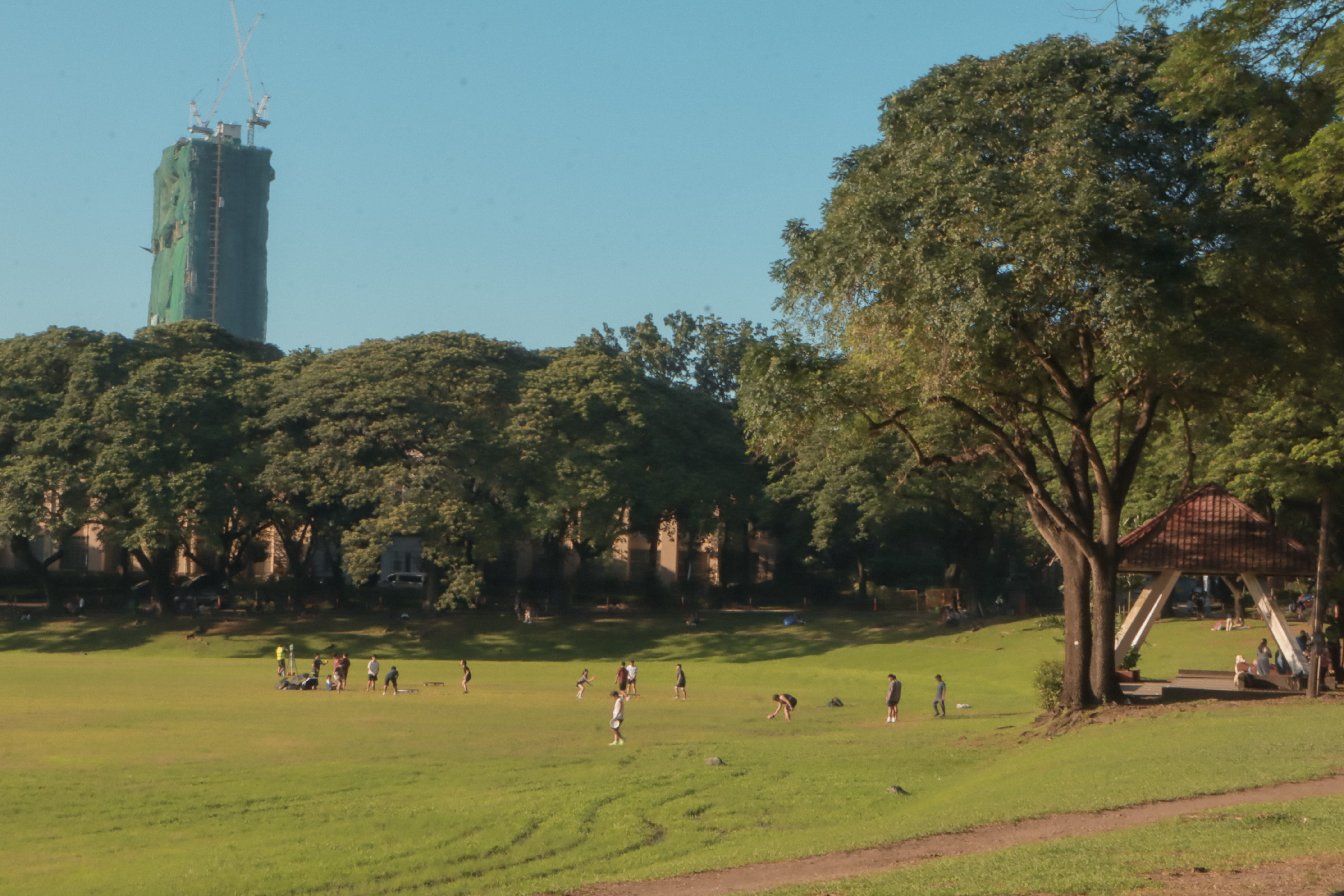
Locals hang out at Sunken Garden, a popular third space within Quezon City, under sunny weather. (Hershey Sta. Brigida/Likas Publication)
Yet, spaces like these are rare, with malls and cafes in their stead. As a result, Filipinos are often discouraged from seeking spaces outside of their homes, as doing so means spending money just to use a space.
“The lack of free third spaces here in the Philippines in general contributes to why people hang around in malls so much, why it's so over-congested in malls, and why some people just prefer to stay home,” Catane said.
Catane also emphasized the importance of third spaces in the realm of children’s health amid the digital age as well as its benefits for those who live in poor conditions.
“Biking spaces, skateboard spaces, just like playgrounds for kids […] I think kids would benefit more from being less on their phone and being more outside. […] I think that [children] would benefit from having better outside spaces where even if they're outside, they're still safe,” Catane added.
Multiple government agencies have acknowledged the issue at hand; the Department of Human Settlements and Urban Development has acted with agencies to draft urban space guidelines; the Department of Environment and Natural Resources announced an increase in green space cover across Metro Manila; Senator Mark Villar has filed a Senate bill that mandates every city to have a public green space.
Yet, these proposed solutions are still awaiting fruition, and the impacts of these gaps are continuously felt by students like Catane and Benitez.